
Ask ten marketers what they're running and you'll get ten different words for the same thing. BVOD. SVOD. Programmatic. CTV. Connected video. YouTube. The industry has spent the last few years arguing about the pipe: which platform, which placement, which acronym gets the budget this quarter.
Here's what we've learned across more than 10,000 campaigns. The pipe fragmented. The psychology didn't.
A person sitting on the couch deciding whether your product is worth their money is running the same mental process they were running twenty years ago, whether the ad reaches them through 7plus, Netflix, a programmatic buy, or a broadcast slot. The delivery changed. The human on the other end did not. So while everyone else sells you a media channel, we start somewhere else entirely: inside the buyer's head.
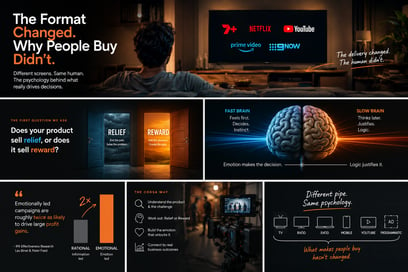
01. THE FIRST QUESTION WE ASK (before format, before budget)
Before format, before budget, before a single frame is storyboarded, answer this: does your product sell relief, or does it sell reward? That one question decides everything downstream, and it is the first thing our commercial creative director works out on every commercial we make. It has nothing to do with where the ad will run.
Put another way: is your customer buying to avoid a pain, or to gain a pleasure? It sounds simple. It is the single most important fork in the road, and it is the one most ads get wrong before a camera ever rolls.
A pain product solves something. It takes away worry, cost, risk, discomfort, hassle. Think insurance, security, accounting software, anything a customer buys because the alternative keeps them up at night. A pleasure product adds something. Status, joy, taste, belonging, the feeling of getting ahead. Think travel, premium food, a car that turns heads, a brand that says something about you.
Get this fork wrong and everything downstream is wrong. The tone is wrong. The pace is wrong. The emotional arc is wrong. The call to action is wrong. You end up with a beautifully produced spot that sells the wrong feeling to the wrong instinct, and no amount of media spend fixes a creative that was pointed in the wrong direction from the start.
02. WHY GAIN OR PAIN IS REALLY AN EMOTIONAL TRIGGER
Choosing between gain and pain is not a rational sorting exercise. It is an emotional one, and that is the part most people miss.
People do not decide with a spreadsheet and then feel something about it. They feel something first, and reach for the spreadsheet afterwards to justify what they already wanted. The decision is made in the fast, instinctive part of the brain. The logic shows up late, mostly to make the buyer comfortable with a choice their gut already locked in.
That is why gain and pain matter so much. They are the two doors into that instinctive part of the brain.
A pain product has to make you feel the relief. Not list the features that theoretically reduce risk, but land the moment where the weight lifts. A pleasure product has to make you feel the reward. Not describe the benefits, but let you taste the win before you've paid for it. In both cases the job is the same: emotion does the heavy lifting, and the information is just there to justify the feeling after the fact.
This is not just instinct talking. The long-running IPA effectiveness research from Les Binet and Peter Field found that emotionally led campaigns are roughly twice as likely to drive large profit gains as rational, information-led ones. Feeling, it turns out, is the more commercial choice.
This is the difference between an ad that argues with you and an ad that moves you. Most weak commercials try to win the argument. They pile on features, specs, and reasons, talking to the slow, rational brain that was never going to make the decision anyway. Strong commercials make you feel the gain or the pain first, then hand your rational brain exactly enough to say yes.
It's the lens our creative director uses to pull apart real ads, successful and unsuccessful, on The Science of Advertising Show. Watch a few episodes and you'll start to see it everywhere. The ads that work are almost never the ones with the most information. They're the ones that picked a side, gain or pain, and made you feel it.
03. THE CORSA WAY
This is how we approach commercial creative, and it doesn't change based on where the ad ends up. BVOD, SVOD, programmatic, broadcast, the diagnosis comes first and the format follows. Understand the product, understand the challenge, work out whether you're selling relief or reward, then build the emotion that unlocks it. Everything else, the craft, the cutdowns, the media plan, is in service of that.
It's also why we measure the way we do. Growth measured in results, not promises. An ad that made people feel something is nice. An ad that made people feel something and then buy is the job. That's where our Amplification pillar earns its place, connecting the creative back to real business outcomes rather than reach for its own sake.
Average is not an option, and average is exactly what you get when you lead with the format instead of the human. The brands that move forward are the ones who understand their customer well enough to know which door to walk through. That understanding is what we bring, campaign after campaign.
The format will keep changing. It always does. What makes a person buy from you won't. Start there, and the rest gets a lot easier.
Want to see the thinking in action? Our commercial creative director breaks down real commercials, the ones that work and the ones that don't, on The Science of Advertising Show.

.png?height=200&name=image%20(4).png)